


One order, five disconnected handoffs
Virtual staging was already Bella's most popular service out of eight. But behind every order was an entirely manual process: Dropbox links for photo uploads, email chains for delivery coordination, no shared system between the ops team and designers. Returning realtors had no way to access order history.


The operation couldn't keep up with the demand.
The team had no visibility into status across active jobs. As volume scaled, the model broke. Turnaround stretched toward 48 hours. On-time delivery rates fell. Modification requests climbed as communication gaps widened. The business had a scaling problem. The question was how to solve it without losing the quality that made clients come back.
Who We're Designing for
For individual real estate agents
We design for real estate agents managing one or multiple listings. With limited time across paperwork, showings, and client meetings, agents need efficient ways to make their listings stand out. They see professional staging as a strategic tool to attract the right buyers and support faster sales.
Traditional staging is costly and time-consuming, especially for agents managing multiple listings. As the market has become more competitive, agents need a faster, more affordable way to stage homes, test different looks, and adapt quickly without the cost and logistics of traditional staging.
Partnership with


Beyond individual agents, the platform also serves large real estate companies looking to integrate staging into their existing workflows. Partnerships with Keller Williams and eXp validated this shift, with Smart Pick identified as a key differentiator. While agents remain the end users, the product evolved from a standalone tool into a scalable SaaS solution that brokerages can embed across their teams.
What We're Staging
The three highest-impact rooms
Order data showed living room, dining room, and bedroom made up most staging requests, from individual agents and franchise partners alike. They're also the rooms buyers spend the most time viewing in listing photos
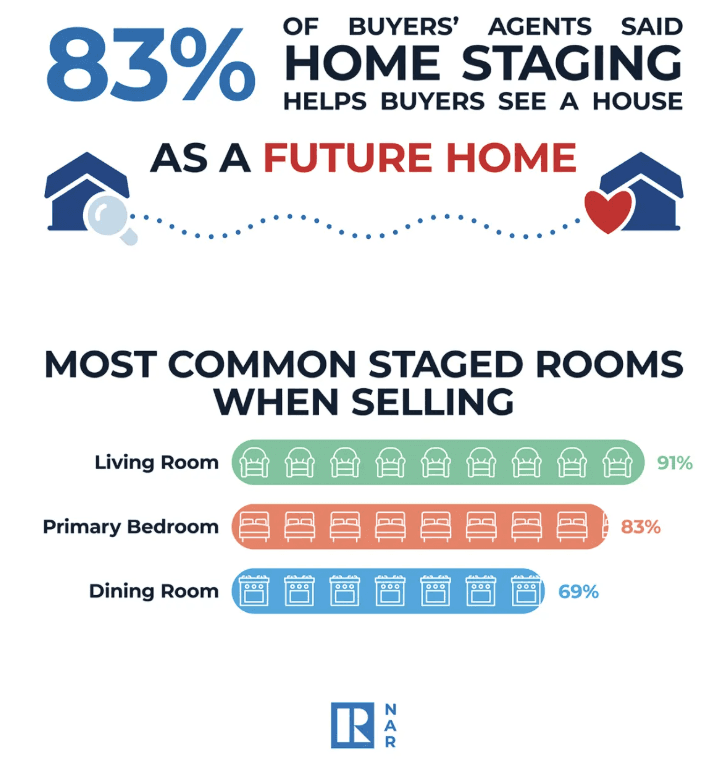
Desk research later confirmed the same pattern nationally. NAR's 2025 Profile of Home Staging found living room (91%), primary bedroom (83%), and dining room (69%) are the most frequently staged rooms industry-wide, matching what the data already showed us.
What if staging decisions weren't based on a designer's gut, but on what actually sells in that neighbourhood, to that buyer profile, at that price point?
That was the design challenge. The team set out to build a system with two interlocking parts: an AI-powered workflow that removes the manual effort, and a data-driven intelligence layer that removes the guesswork.
Virtual staging already existed. The tools worked. So why rebuild it with AI?
Speed was the first reason. Traditional staging required a human editor for every room. AI could do the same job in seconds, at scale, with no queue.
Consistency was the second. Human editors vary. AI doesn't. Every listing gets the same quality baseline, regardless of who's requesting it or when.
The third reason was the hardest to solve with a human: relevance. No editor knows the local buyer market for every neighbourhood. But a system trained on MLS data does. AI unlocked the ability to match staging style to buyer profile at a level no manual process could replicate.
That's what made this more than an efficiency play. It was a chance to make staging smarter, not just faster.
Process, & Concept testing
One system, two audiences
The design challenge wasn’t simply whether to use AI, but how to build one system that could serve both individual agents and large brokerages: fast and affordable for single orders, yet reliable and scalable for high-volume workflows.
The expectations are different. An individual agent may accept revisions, while a brokerage processing hundreds of photos a day needs consistent results from the first pass.
Designing an AI-Assisted Staging Workflow
We decided to use AI to automate repetitive tasks such as background removal and furniture removal, helping agents and the internal team move from upload to staged image faster. But a key challenge emerged: how do we make sure AI-generated results meet a consistent quality standard?
Defining What “Good” Looks Like
Rather than relying on personal judgment alone, we built an internal rating platform where design, operations, and other team members could evaluate staged images from multiple perspectives. We combined this feedback with historical customer satisfaction data to define a shared quality standard.
The evaluation covered both objective and subjective dimensions, including:
Photorealistic quality: lighting, shadowing, furniture size, layout, human logic
Staging quality: resolution, colour, texture
Wow factor: visual appeal and personal preference

These criteria were consolidated into a standardized SOP, creating a clearer definition of what a “high-quality” virtual staging image should look like. This framework also gave us structured data that could be fed back into the AI workflow to continuously improve its output.
Designing Around AI’s Limitations
Through testing, we also found that AI still struggled to accurately understand 3D space from a 2D image. Room dimensions, furniture scale, and proportions could be inconsistent, especially when generating furniture directly from a single reference image.
To reduce these errors, we adapted our asset pipeline. Instead of relying on AI to reconstruct furniture in 3D, we converted existing 3D Max furniture models into 2D image references from multiple angles. This gave the AI richer visual information while keeping the final output in the 2D format required for virtual staging.
The result was a hybrid workflow: AI handled speed and repetitive tasks, while structured quality standards, curated assets, and human review helped maintain consistency.

Where it held, and where it didn't
The problem split across two models, with every output kept on a short leash before it reached a client. Furniture removal was fast and reliable, the AI handled that step cleanly and consistently. Staging was the harder half: results weren't always stable, and getting furniture size and position right was consistently the trickiest part to nail, even with good input images.
That instability is what kept AI from meeting the bar a high-volume client like Keller Williams needed at scale and it's what shaped the platform's tiered structure: AI-first for speed on individual orders, with an Upgrade to Studio path for jobs that need a level of precision AI can't yet guarantee.
The Solution
Two systems. One seamless experience.
We first built a centralized platform for project upload and delivery. Clients use the link in their order email to upload photos, view purchased services, and manage multiple photo orders in one place.

After delivery, clients can review each photo, rate their satisfaction, and leave comments or revision requests.

A realtor shouldn't need to know anything about AI to benefit from it.
The team integrated Gemini (Nano Banana) directly into the staging flow. Invisible infrastructure, visible results. One click clears the furniture.
Seconds later, a fully staged room appears. Partner furniture sets make outputs feel real, not rendered.
The whole experience went from a multi-step manual job to something a realtor could trigger, review, and send without thinking about the AI behind it.

Before → After
Empty room to market-ready listing, in seconds.
The AI handles removal and staging in one guided flow. No complex tools. No back-and-forth with an editor. Realtors stay in control — the AI just handles the heavy lifting.


Drag the slider to see the before-and-after of AI furniture removal.


Drag the slider to see the before-and-after of AI Virtual Staging result.
Good staging isn't just about aesthetics. It's about relevance. Smart Pick uses MLS listing data to understand who's likely buying this property and surface staging styles that match. It turns a subjective choice into an informed one — and gives Bella a data layer competitors without MLS integration can't replicate.
How it knows what to recommend
The realtor enters a property address, and Smart Pick handles the rest — three ranked, brand-matched picks come out the other side.

Designing trust, not dependency
The hardest problem wasn't getting the AI to work. It was getting realtors to trust it. We built a confidence score — "94% buyer match" — tested it internally, and cut it. A percentage sounds precise but it's not explainable in terms a realtor can verify. It created more questions than it answered. The final design shows reasoning through context instead: brand × property type × market intent. Recommendations are transparent (you can see why a style was suggested), overridable (realtors always have final say), and light (suggestions never block the workflow). Explainable beats accurate when trust is what you're building.


From Staging to Listing-Ready Content
With the Smart Pick foundation in place, we expanded the platform with complementary marketing tools. Realtors can resize approved staging photos for different platforms, add their logo, and automatically apply the required virtual staging watermark.
We also introduced AI Description, which generates an MLS-ready property description from the listing details. Information entered during upload can be used automatically, or added later when generating the description.


What changed
The numbers moved fast once the new system shipped.
Both partners cited Smart Pick as the key differentiator.

What was hard
Current AI staging works in 2D: it analyses a flat image and composites furniture into it, but cannot fully understand a 3D space from every angle. Through internal testing, we found that 45° consistently produced the most accurate and natural results.
Instead of treating this as a limitation, we built the guidance into the upload flow to help users capture better photos. Better input leads to better output, fewer revisions, and faster delivery.
Smart Pick also became a key differentiator in conversations with Keller Williams and eXp, with both partnerships highlighting its data-driven recommendations as a reason to integrate the platform into their realtor workflows.
Building AI into a product isn’t just a feature decision, it’s a trust decision. The interface needs to build confidence before users can experience the value of AI. On Bella, the biggest design win wasn’t simply making AI more powerful, but making it reliable and easy enough for realtors to trust and use.
Bella also reinforced an important lesson about two-sided platforms: internal tools are part of the product experience. The operations and designer dashboard is where quality is managed and delivery happens. A strong client experience depends on giving the teams behind it an equally effective system to work with.
Smart Pick’s current matching logic is intentionally a simple starting point, not the final model. We plan to add AI-assisted tagging and confidence scoring once enough real order data is available to train and validate the system.
The next phase will expand into room-specific recommendations, multi-photo support, and inventory-aware ranking. We also plan to close the feedback loop between staging results and sales outcomes, while exploring deeper integrations with Keller Williams and eXp as the platform scales.